Why Startups Fail at Brand Consistency + How to Fix It
by Jake Drummer
17 Min Read
Published On : 24th October, 2025
- Introduction
- Subtopic-1
- Subtopic-2
- Subtopic-3
- Subtopic-3
- Conclusion
You know what’s wild? When you’re building a startup, it’s like juggling flaming swords, product’s gotta be perfect, you’re chasing funding like it’s oxygen, and let’s not even talk about customer growth. But while all that’s going on, there’s this sneaky little thing lurking in the background that ends up wrecking a lot of great startups, yep, inconsistent branding.
Now, here’s the kicker, real numbers, not just gut feeling. CB Insights looked at 101 startup post-mortems (yep, actual failed ones), and guess what? 14% said bad marketing helped dig the grave. And when you zoom in, brand inconsistency played a bigger role than most founders care to admit. Also, get this, 68% of marketing folks swear brand consistency is key to growth, but only 25% of startups bother to make proper brand guidelines in their first year (according to Lucidpress and Demand Metric). Like... seriously?
Talking of chaos, most startups today are posting on 5-7 different social platforms (Twitter, LinkedIn, Insta... you name it), selling across a bunch of channels, and emailing, pinging, messaging their way to customer hearts. And they’re doing all that while hiring, fixing bugs, and maybe sleeping once a week. So yeah, without solid systems, keeping the brand consistent? Almost impossible. That’s why building reusable content systems, brand templates, and visual standards early on can become a silent time-saver — and we’ve seen how even simple design frameworks drastically reduce brand drift for lean teams. Things just start slipping, first the colors go off, then the tone’s weird, then the logo gets stretched like pizza cheese in someone’s pitch deck.
So in this guide, we’re diving into why so many new startups kinda suck at staying on-brand, and what they can do (without needing a full-blown marketing army) to fix it. We’ll talk about the usual traps that even the smartest teams fall into, and throw in real stuff you can actually use, stuff that won’t burn your budget or waste your time.
Ready to stop looking like five different companies on five different platforms? Let’s go!
Key Takeaways
- Brand consistency is a business necessity, not a luxury: Consistent branding across all touchpoints increases revenue by 23% on average and builds crucial trust for startups asking customers to try something new.
- Startups struggle with consistency due to four main factors: Limited resources, lack of brand guidelines, team growth challenges, and the pressure to maintain presence across numerous digital platforms.
- Warning signs of brand inconsistency include: Visual discrepancies in logos and colors, shifting messaging and value propositions, inconsistent tone of voice, and fragmented customer experiences.
- Building consistency requires systems, not just guidelines: Create accessible brand documentation, implement simple approval workflows, and develop templates that make on-brand content the easiest option.
- Brand consistency should evolve intentionally: Balance maintaining your core identity with necessary adaptation for different platforms and growth stages through planned evolution rather than random drift.
- Start with immediate actions: Conduct a brand audit, create a simple brand cheat sheet, designate a brand guardian, and fix the most visible inconsistencies to build momentum for more comprehensive brand management.
Understanding Brand Consistency for Startups
What Exactly Is Brand Consistency?
Brand consistency goes far beyond slapping the same logo on all your materials, it's about creating a seamless, recognizable experience at every single touchpoint with your audience. When we talk about brand consistency for startups, we're referring to the uniform presentation of your company's:
Dr. Jonah Berger, marketing professor at Wharton School and author of "Contagious: Why Things Catch On," explains it perfectly: "Consistency doesn't mean saying the same thing over and over again. It means saying different things that all reinforce the same core identity."
- Visual identity: Your logo, color palette, typography, imagery style, and design elements
- Voice and messaging: The tone, vocabulary, and core messages you communicate
- Values and positioning: What you stand for and how you differentiate from competitors
- Customer experience: How people feel when interacting with your product, service, and team
"Consistency doesn't mean saying the same thing over and over again. It means saying different things that all reinforce the same core identity."
The human brain is wired to seek patterns and familiarity. When your audience encounters consistent brand elements across different contexts, their recognition and recall improve dramatically. In fact, consistent presentation of a brand has been shown to increase revenue by 23% on average (Source: Demand Metric in Partnership with Lucidpresss).
For startups specifically, brand consistency operates as a powerful trust signal in a world where you're asking customers to take a chance on something new and unproven. Every inconsistency creates a tiny fracture in that trust.
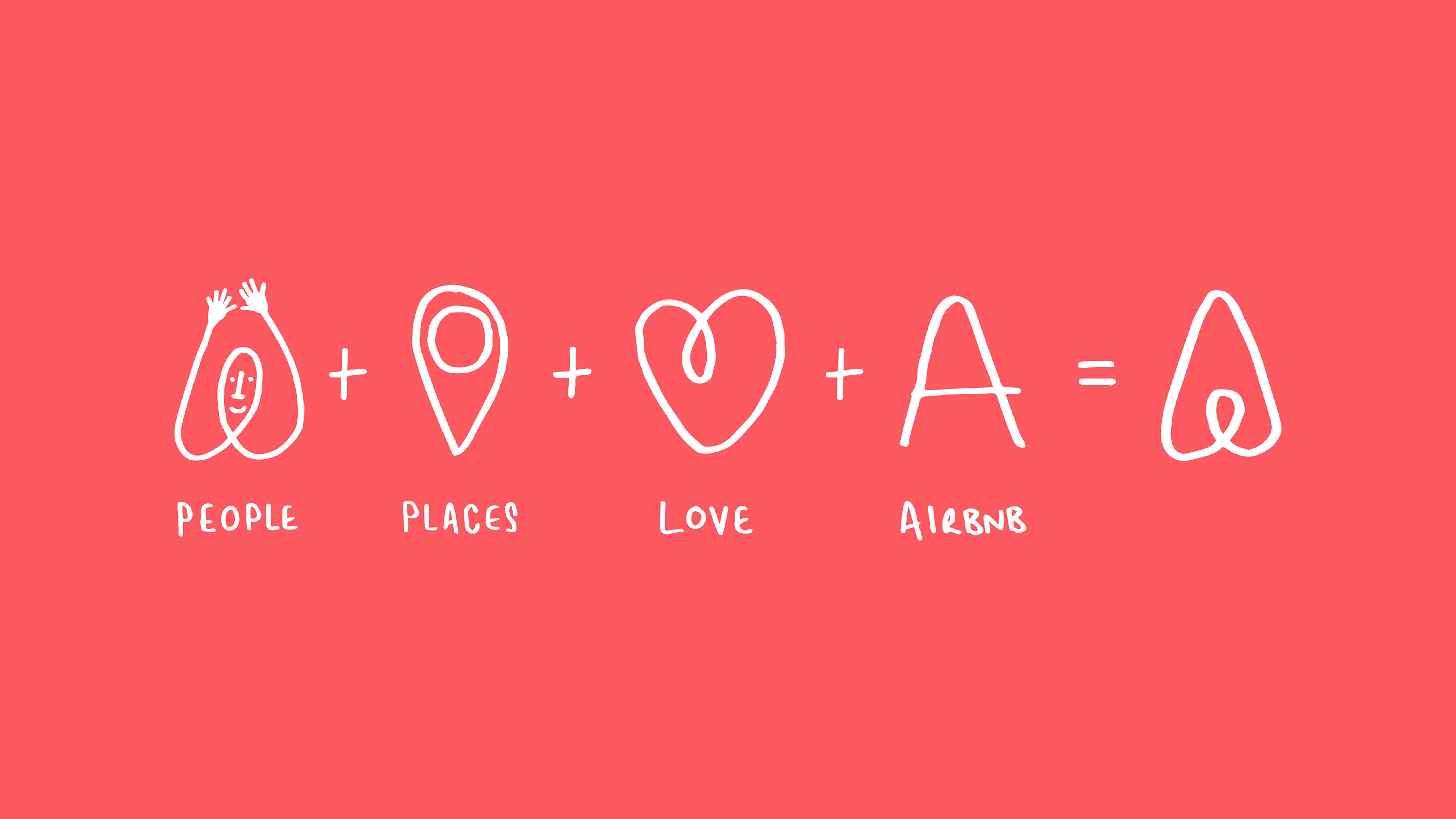
Take Airbnb's evolution as an example. Despite growing from a small startup renting air mattresses to a global hospitality giant, they've maintained remarkable brand consistency. Their 2014 rebrand introduced the "Bélo" symbol, representing "belonging anywhere", which has remained consistent across all touchpoints while allowing for necessary evolution. This consistency has helped them build a brand valued at over $47 billion despite facing an industry disrupted by the pandemic.
Credit: Further Agency
Why Brand Consistency Matters Specifically for Startups
For established corporations, brand inconsistencies might cause temporary confusion. For startups, they can be existential threats. Here's why consistency matters even more when you're just getting started:
1. You have fewer brand impressions to work with
Unlike established players, startups don't have the luxury of thousands of previous brand impressions to fall back on. Every interaction truly counts. Research in Marketing Psychology suggests that consumers typically need between 5-7 brand impressions before they remember your brand. If those limited impressions contradict each other, you're essentially starting from zero each time.
2. Trust is your most valuable currency
Startups are inherently asking customers to take a risk on something unproven. Consistent branding helps bridge this "trust gap." According to a 2023 Edelman Trust Barometer Special Report, 88% of consumers say they need to be able to trust a brand to do what is right before making a purchase, and visual and messaging consistency are key indicators that trigger trust.
3. Resources are scarce, and efficiency is critical
When your marketing team consists of one overworked person (often the founder), inconsistent branding creates enormous waste. Every time you recreate assets or rethink your messaging approach, you're burning precious time and money. A 2022 Frontify Brand Management Report found that brands with strong consistency protocols save an average of 16 hours per week on content creation costs, resources startups desperately need elsewhere.
4. Your competition is just a click away
In today's digital environment, potential customers can jump to your competitors with minimal friction. A study by Stanford Web Credibility Research found that 46.1% of users make judgments about a company's credibility based on visual design alone, and inconsistency is one of the fastest ways to damage that credibility.
The hard truth is that most startups severely underestimate the impact of brand consistency on their growth trajectory. Many technical founders treat brand as an afterthought rather than a strategic pillar—often wondering why their superior product isn’t gaining traction. While this sentiment is widely acknowledged in startup circles, it's especially relevant in the context of advice often shared by experts like Michael Seibel of Y Combinator, who regularly emphasizes the importance of user perception and business fundamentals beyond just the product.
In a revealing study by Tenet Partners, the companies with the most consistent brands enjoyed 3.5 times more visibility than those with inconsistent brand presentation. For cash-strapped startups without massive advertising budgets, this visibility multiplier represents one of the highest-ROI marketing investments available.
Why New Startups Struggle with Brand Consistency
Understanding the importance of brand consistency is one thing; actually achieving it is quite another. Let's examine why so many promising startups stumble when it comes to maintaining a consistent brand presence.
Limited Resources and Competing Priorities
The brutal reality of startup life is that everything feels urgent, but resources are painfully finite. When forced to choose between fixing a critical product bug or updating marketing materials for brand consistency, most founders will (understandably) prioritize the former.
This resource crunch manifests in several predictable ways:
Research from Gartner reveals that marketing budgets for early-stage startups average just 7.7% of overall company spending, with only a fraction of that dedicated to brand management. With such limited resources, maintaining consistency often falls by the wayside in favor of more immediate concerns.
- DIY design decisions made by team members without design training
- Quick-turnaround marketing materials created under deadline pressure
- Bootstrapped visuals that evolve haphazardly as the company grows
- Placeholder branding that somehow becomes permanent
Lack of Brand Guidelines and Systems
The foundation of brand consistency is a robust set of brand guidelines.
Without clear documentation, each team member inevitably develops their own interpretation of the brand. The "official" logo might exist in twelve slightly different versions across various team members' computers. The company voice might shift dramatically depending on who's writing the copy that day. We often help early-stage teams build lightweight but highly usable brand guideline kits, not just logos and colors, but voice and tone breakdowns, templates, and even internal vocabularies. It brings instant alignment, especially when scaling fast.
Mailchimp, now a marketing automation giant, struggled with this exact problem in its early days. Co-founder Ben Chestnut has been open about how the company's early communications lacked cohesion until they invested in developing their now-famous brand guidelines and distinctive voice.
The most common guideline-related issues include:
- Nonexistent documentation: No formal record of brand standards exists
- Incomplete guidelines: Basic elements like logos are documented, but voice/tone guidelines are missing
- Inaccessible resources: Guidelines exist but aren't easily available to all team members
- Outdated standards: Guidelines don't evolve as the company and product mature
Even when guidelines do exist, they often sit unused in a forgotten Google Drive folder. Without systems to make brand assets easily accessible and usage rules clear, consistency remains elusive regardless of documentation quality.
Team Growth and Communication Challenges
As startups scale, maintaining brand consistency becomes exponentially more difficult. What worked when three co-founders shared an apartment simply doesn't translate to a team of 30 spread across multiple time zones.
Consider these common scenarios that plague growing startups:
1. New hires lack proper brand onboarding. They're thrown into creating customer-facing materials without understanding the brand's voice or visual standards. A few onboarding workshops or even a single internal storytelling session can help new team members carry your brand forward with confidence. We’ve run these in fast-paced environments, and the clarity it brings is immediate.
2. Marketing works in isolation from product. The marketing team develops messaging that doesn't align with how the product team describes features.
3. Freelancers receive incomplete briefings. External designers or writers create materials based on their best interpretation of the brand rather than clear guidelines.
4.Founders become bottlenecks. All brand decisions must flow through founders who are already stretched thin.
Buffer, under the leadership of marketing figures like Kevan Lee, recognized that as they scaled to over 80 remote employees, maintaining a consistent brand required explicit systems and ownership to prevent dilution and fragmentation.
Platform Proliferation and Channel Expansion
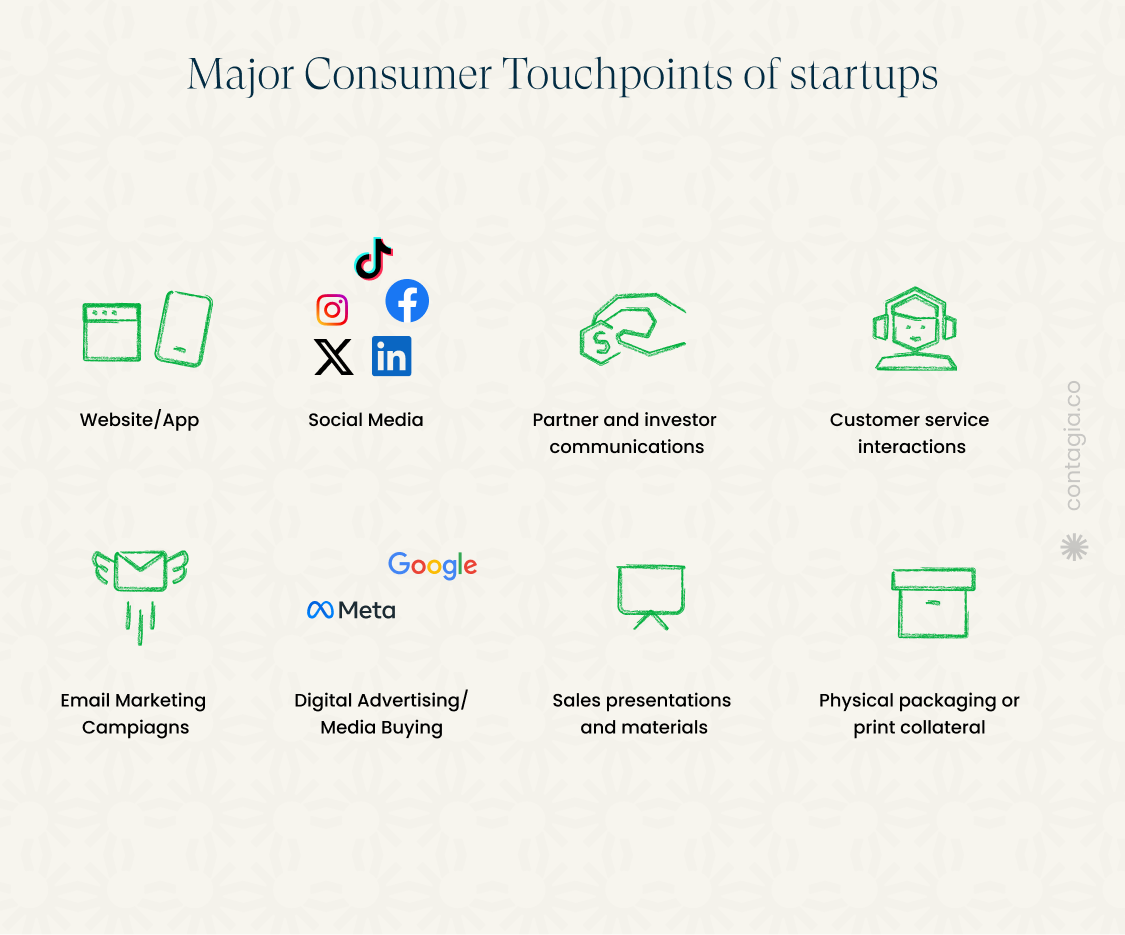
Today's startups face unprecedented pressure to maintain a presence across a dizzying array of platforms. Your brand might simultaneously need to exist on:
Each channel has unique constraints and audience expectations. Twitter (now X) demands brevity and personality. LinkedIn rewards more formal, value-driven content. TikTok thrives on authenticity and creativity. Your website needs to convey professionalism and clarity.
- Your website and mobile app
- 5-7 social media platforms (each with different format requirements)
- Email marketing campaigns
- Digital advertising across multiple networks
- Content marketing channels
- Sales presentations and materials
- Physical packaging or print collateral
- Customer service interactions
- Partner and investor communications
These divergent requirements create natural tension with brand consistency. Adapting your message to each platform without losing your core identity requires sophisticated brand management that many startups simply haven't developed.
Consider this telling statistic from the Content Marketing Institute: 65% of B2B marketers report having trouble creating consistent content across their marketing ecosystem, and that percentage jumps to 78% for companies with fewer than 50 employees.
Signs Your Startup Is Failing at Brand Consistency
How can you tell if your startup is falling into the brand consistency trap? Look for these telltale signs that your brand presentation is fragmenting:
Visual Inconsistency Red Flags
The most immediately obvious inconsistencies typically appear in your visual identity. Keep an eye out for:
1. Logo variations proliferating
Take a hard look at your logo usage across all channels. Are you seeing subtle differences in color shades? Different spacing around the logo? Inconsistent sizing or positioning? These variations might seem minor in isolation but create cumulative confusion.
One particularly problematic pattern occurs when different departments create their own "versions" of your logo for specific needs. The marketing team might use one variant while the product team embeds a slightly different one in the app.
2. Color chaos
Your brand likely has an official color palette, but is it being faithfully implemented? Common issues include:
Color inconsistency is particularly damaging because humans process color information before they consciously register logos or text. When your blues don't match across touchpoints, it creates subtle but real cognitive dissonance.
- Inconsistent hex codes used across digital platforms
- Print materials using different color values than digital assets
- Team members eyeballing colors rather than using official palette codes
- Gradient implementations varying between applications
3. Typography and image style discrepancies
Typography inconsistency often manifests through:
Similarly, your visual imagery may lack cohesion in:
- Different font families appearing across materials
- Inconsistent heading hierarchies and sizing
- Variable line spacing and paragraph formatting
- Font weight variations that don't align with guidelines
- Photography style (lighting, composition, subject matter)
- Illustration consistency (line weight, style, color application)
- Icon design approach (filled vs. outlined, corner radius, stroke width)
- Overall aesthetic feel (modern vs. traditional, playful vs. serious)
4. Design quality fluctuations
Perhaps most telling is when the overall quality of your design materials varies dramatically. This often happens when different team members with varying design skills create assets, or when rushed deadlines force compromises.
When some of your materials look polished and professional while others appear amateur, customers notice, and it undermines trust in your overall competence
Messaging and Communication Inconsistencies
Beyond visual elements, inconsistent messaging creates profound brand confusion:
1. Shifting value propositions and unclear positioning
When your core value proposition changes depending on which page of your website someone visits or which team member is speaking, you've got a consistency problem. Look for:
One startup I consulted with had eight different versions of their elevator pitch in active use across their website, pitch deck, social profiles, and team communications. Each version emphasized slightly different value propositions, creating confusion about what the company actually did best.
- Different explanations of what problem your product solves
- Varying descriptions of your primary target customer
- Inconsistent articulation of key differentiators
- Fluctuating emphasis on features vs. benefits
2. Tone of voice variations between channels
Your brand should have a recognizable "voice" regardless of channel, but inconsistency often emerges:
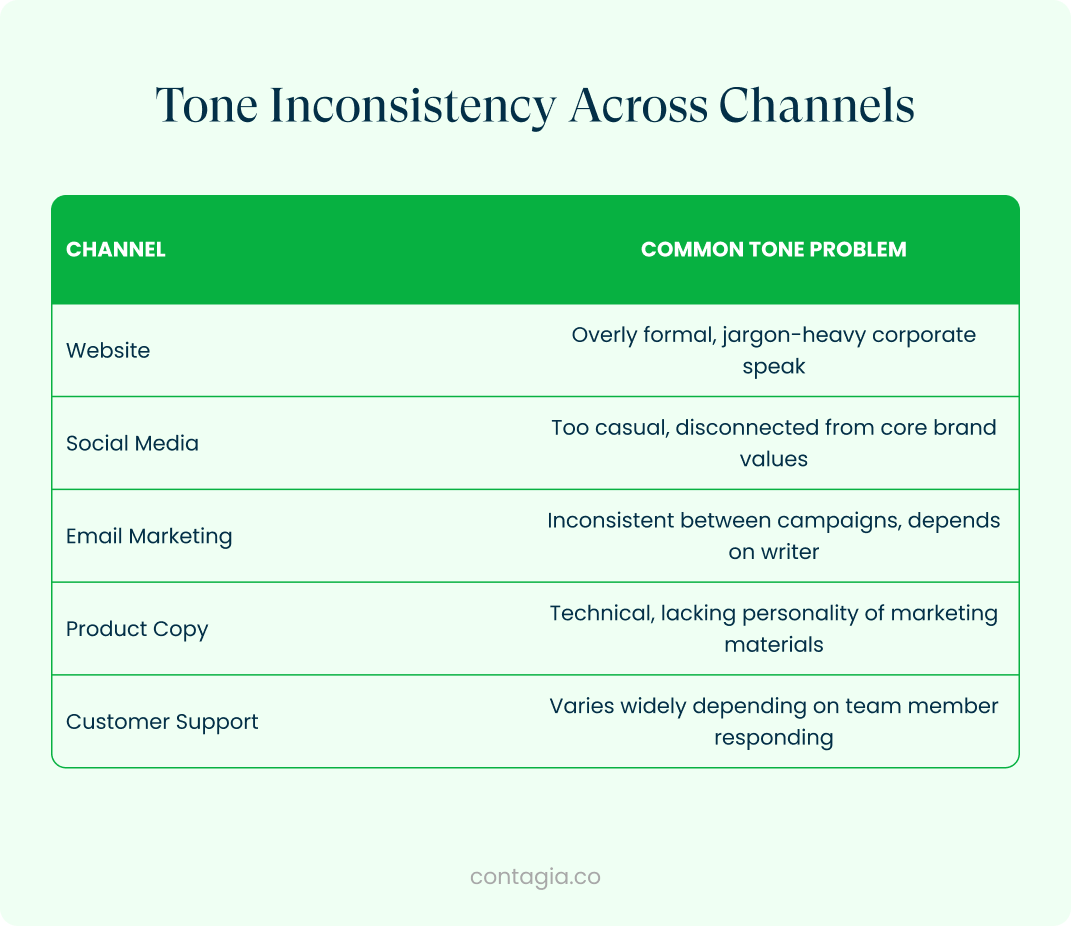
- Formal, jargon-heavy language on your website with casual, emoji-filled social posts
- Professional email communications but overly casual customer support responses
- Blog content that reads like it was written by different companies
- Significant personality differences between marketing and product copy
This table illustrates how tone inconsistency typically manifests across channels
3. Mixed messages about company mission and values
Does your "About Us" page proclaim one set of values while your CEO's conference talks highlight completely different ones? Do your hiring materials emphasize a mission that's barely mentioned in your customer-facing content?
When your fundamental purpose and values seem fluid rather than fixed, it erodes trust and confuses both employees and customers about what you truly stand for.
Customer Experience Fragmentation
The ultimate brand inconsistency appears in how customers actually experience your company across touchpoints:
1. Disjointed experiences between touchpoints
Map your typical customer journey and watch for experience disconnects like:
2. Feedback flagging inconsistencies
- A high-energy, friendly sales process followed by a formal, technical onboarding
- Premium branding on your website but generic, template-feeling email communications
- Sophisticated digital experience but bargain-basement packaging
- Inconsistent knowledge levels between customer support team members
Your customers will tell you, directly or indirectly, when they experience brand consistency issues. Look for feedback patterns like:
Modern consumers have highly tuned radars for brand authenticity. When different parts of your organization present contradictory faces to the world, people notice, and their trust erodes accordingly.
- "This doesn't feel like the same company I signed up with"
- Confusion about what services or features you actually offer
- Surprise about your company's tone or approach in certain channels
- Questions that indicate your positioning isn't clear
How Startups Can Create a Powerful Brand Through Consistency
Now for the constructive part: how can startups overcome these challenges and build powerfully consistent brands without enterprise-level resources? Let's explore practical, implementation-focused strategies:
Developing Comprehensive Brand Guidelines
1. Core components every startup brand guide needs
Even the simplest brand guidelines should cover:
- Logo: All approved versions, clear space requirements, minimum sizes, and usage rules
- Color palette: Primary and secondary colors with hex codes, RGB values, and CMYK equivalents
- Typography: Primary and secondary fonts with usage hierarchies and alternatives for situations when primary fonts aren't available
- Voice and tone: Personality attributes, vocabulary guidelines, and examples of appropriate voice in different contexts
- Visual style: Guidance on photography, illustration, iconography, and other visual elements
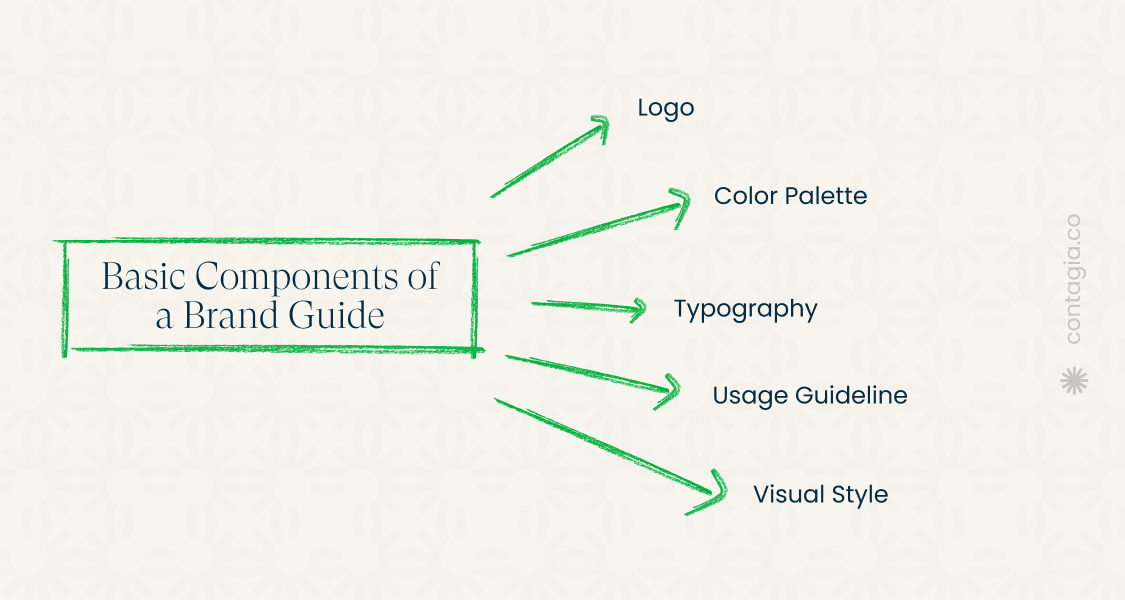
For startups, these don't need to be 100-page documents. A concise, clear 10-15 page guide is far better than an elaborate document no one reads.
2. Making guidelines accessible and actually useful
The best brand guidelines in the world are useless if your team can't easily access and apply them. Consider:
- Hosting guidelines in a cloud-based tool everyone can access (not buried in someone's email)
- Creating a simplified one-page "quick reference" version for daily use
- Including actual templates and examples, not just abstract rules
- Building guidelines collaboratively so the team feels ownership
Canva, despite creating design tools, recognized the challenge of maintaining brand consistency, especially in their early days. Co-founder Melanie Perkins' philosophy emphasized the need for dynamic, evolving brand guidelines, rather than static documents. Their solution was to develop an intuitive brand management system within their own platform, making it enjoyable for team members to consistently apply brand elements.
3. Digital asset management for the resource-constrained
You don't need enterprise software to manage your brand assets effectively. Consider these affordable approaches:
- Use tools like Figma or Google Drive to create a centralized asset library
- Create clear file naming conventions that everyone follows
- Develop a simple system for versioning assets so outdated materials don't linger
- Regularly audit and clean up asset repositories
Most importantly, designate a clear "owner" of brand assets who ensures guidelines are followed and updated as needed.
Building Brand Management Systems
Guidelines alone aren't enough, you need systems that make consistency the path of least resistance:
1. Templates as consistency enforcers
Well-designed templates dramatically improve brand consistency while saving time. Invest in creating templates for:
- Social media graphics for different platforms
- Blog post and content marketing layouts
- Email marketing campaigns
- Sales presentations and proposals
- Internal communications
We’ve helped teams create adaptive templates that feel native across different platforms while still staying unmistakably ‘on-brand’ — it’s not about looking the same everywhere, but about feeling the same. The key is making these templates genuinely useful, not just on-brand but also easy to modify for specific needs. When the branded option is also the most convenient option, adoption soars.
2. Simple approval workflows that don't create bottlenecks
Larger companies typically have formal brand approval processes, but startups need something more agile. Consider:
- Designating specific team members as "brand champions" who can approve materials
- Creating a simple checklist that team members can use for self-review before publishing
- Using collaboration tools with commenting features for lightweight reviews
- Setting different approval thresholds based on content visibility and permanence
Gusto, the payroll and HR platform, is known for its approach of fostering "freedom within frameworks", this philosophy guides their brand strategy by establishing clear brand guardrails while empowering team members to work independently within those boundaries, reducing the need for constant approval on every brand expression.
3. Regular brand audits
Even with the best systems, inconsistencies creep in over time. Schedule regular brand audits to catch and correct drift:
- Monthly quick-checks of high-visibility touchpoints
- Quarterly deeper reviews across all channels
- Annual comprehensive brand audits that include customer perception
We, at Contagia, usually recommend quarterly micro-audits, just a few hours of visual and verbal check-in, which can save weeks of rework down the line.
Building a Brand-Conscious Culture
Systems and guidelines matter, but culture is what truly drives consistency:
1. Making brand part of onboarding
Every new team member should understand your brand fundamentals from day one:
- Include brand overview in onboarding materials
- Explain not just what your brand guidelines are but why they matter
- Provide examples of excellent brand execution to set the standard
- Connect brand consistency to business outcomes so it feels meaningful, not arbitrary
2. Democratizing brand knowledge
Brand consistency improves when everyone, not just marketers, understands and values the brand:
- Hold occasional brand workshops for the entire team
- Create accessible explanations of brand decisions and evolution
- Celebrate and share examples of great brand execution. In some cases, we’ve developed democratized brand kits, condensed guides that anyone, from engineers to customer support, can use without formal design training.
- Invite feedback and ideas from all departments
When engineers and customer support specialists understand your brand as deeply as your designers do, consistency emerges naturally across all touchpoints.
3. Leading by example
Leadership sets the tone for brand consistency. When founders and executives:
- Take time to get communications right rather than rushing
- Reference brand guidelines in their decision-making
- Correct their own inconsistencies transparently
- Recognize and praise consistent brand execution
...the rest of the team follows suit.
Balancing Consistency with Necessary Evolution
Brand consistency doesn't mean rigidity. The most successful startup brands evolve thoughtfully:
1. Planned evolution vs. random drift
The difference between strategic brand evolution and inconsistency is intentionality. Create processes for:
- Regularly evaluating whether your brand still reflects your market position
- Collecting feedback on how your brand is perceived
- Making deliberate decisions about brand updates
- Communicating changes clearly to your entire organization
2. Platform-specific adaptations that maintain core identity
Different platforms require adaptability without losing your essence:
- Identify which brand elements are immutable across all channels
- Create platform-specific guidelines that acknowledge channel differences
- Focus on maintaining consistent brand feeling even when formats must change
- Use consistent visual or verbal cues that tie varied executions together. Especially in digital-first brands, the challenge isn’t choosing a platform — it’s adapting your essence to each one. That’s where strategic design and messaging frameworks really shine.
Stripe, the payment processing platform, exemplifies this balance perfectly. Their distinctive color palette and geometric patterns remain instantly recognizable whether they appear in their documentation, on social media, or in their product interface, but they adapt intelligently to each context without feeling formulaic.

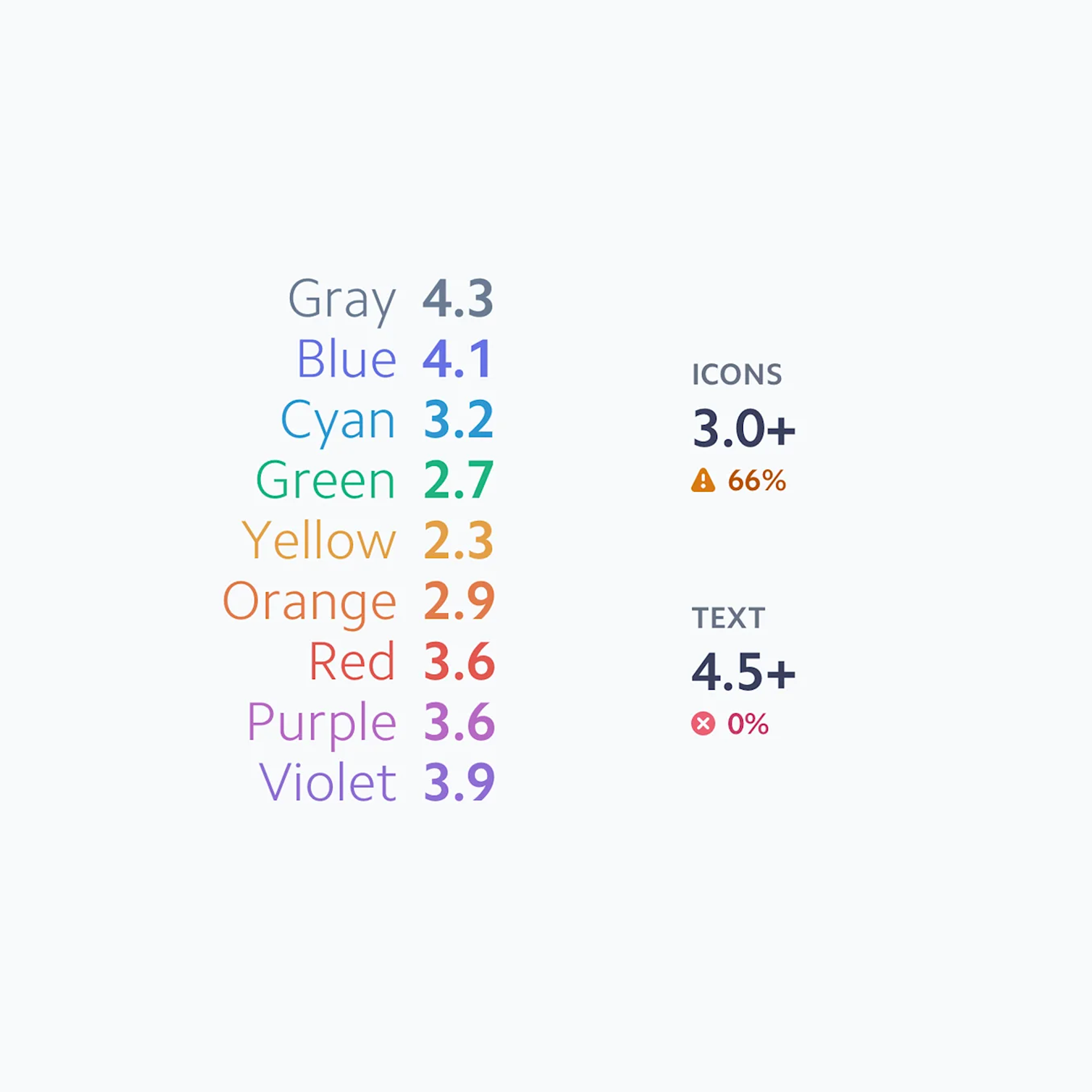
Source: Stripe
Case Studies: Brand Consistency Success Stories
Theory is helpful, but seeing principles in practice is even better. Let's examine three startups that overcame brand consistency challenges:
How Notion Built a Cult-Like Brand While Scaling Rapidly
When Notion launched in 2016, it entered the crowded productivity space against entrenched competitors like Evernote and Microsoft. Despite rapid growth to over 20 million users, they've maintained remarkable brand consistency.
The challenge: Scaling from 4 employees to over 200 while maintaining their distinctive minimalist aesthetic and quirky personality.
Their approach:
1. Distinctive visual identity: Notion developed a unique black-and-white aesthetic with playful illustrations that was simple enough to maintain consistently across all touchpoints.
2. Comprehensive template system: They built an internal design system that made it nearly impossible to create off-brand materials.
3. User community involvement: By embracing and amplifying user-generated content that aligned with their brand, they extended their reach while maintaining consistency.
4. Strong tone of voice guidelines: Their communication has maintained a consistent balance of approachability and professionalism regardless of channel.
Results: Notion has built such strong brand recognition that users can identify their content even without seeing their logo. Their consistent brand has helped them achieve a $10 billion valuation despite spending relatively little on traditional marketing.
Notion's brand strategy, guided by insights from their Head of Design Jess Lam, emphasizes a focus on functional elegance over fleeting trends. This deliberate approach has been instrumental in maintaining brand consistency throughout the company's growth.
How Ramp Maintained Brand Consistency Through Rapid Category Expansion
Ramp launched in 2019 as a corporate card startup but quickly expanded into expense management, bill payments, and broader financial services.
The challenge: Maintaining a cohesive brand identity while rapidly expanding product offerings and target audiences.
Their approach:
1. Centralized design leadership: Maintaining a core brand team that approves all major brand expressions.
2. Modular brand system: Creating flexible but consistent components that could be recombined for different products and audiences.
3. Regular brand refreshes: Planning intentional brand evolution to accommodate growth rather than allowing ad-hoc changes.
4. Cross-functional brand training: Ensuring product, engineering, and sales teams understood brand principles, not just the marketing department.
Results: Despite expanding from one to seven product categories in under three years, Ramp has maintained strong brand consistency—evident in its seamless design system, unified messaging, and product-led growth approach that continues to drive standout recognition in the fintech space.
How Loom Balanced Brand Consistency with Market Adaptation

Video messaging platform Loom faced the challenge of appealing to multiple distinct audiences, from individual creators to enterprise teams, without diluting their brand identity.
The challenge: Adapting their messaging and visual presentation for different market segments while maintaining a recognizable brand.
Their approach:
1. Clear brand architecture: Developing distinct but related sub-brands for different offerings.
2. Consistent core elements: Maintaining absolute consistency in logo, color palette, and typography while allowing flexibility in imagery and tone.
3. Detailed style guide with examples: Creating extensive documentation showing how their brand should appear in different contexts.
4. Regular brand audits: Conducting quarterly reviews of all brand touchpoints to identify and correct inconsistencies.
Results: Loom has successfully expanded from serving individual users to attracting enterprise clients, largely while maintaining its distinctive, user-friendly personality and avoiding significant brand confusion. While specific NPS scores across all customer segments are proprietary, Loom's overall NPS is generally considered strong, indicating a broad alignment between their brand promise and customer experience as they've grown their user base. Their continued growth into the enterprise space suggests their core value proposition resonates across different customer needs.
Action Plan for Startups to Improve Brand Consistency
Let's conclude with a practical, timeline-based action plan for startups looking to strengthen their brand consistency:
Immediate Steps (Next 7 Days)
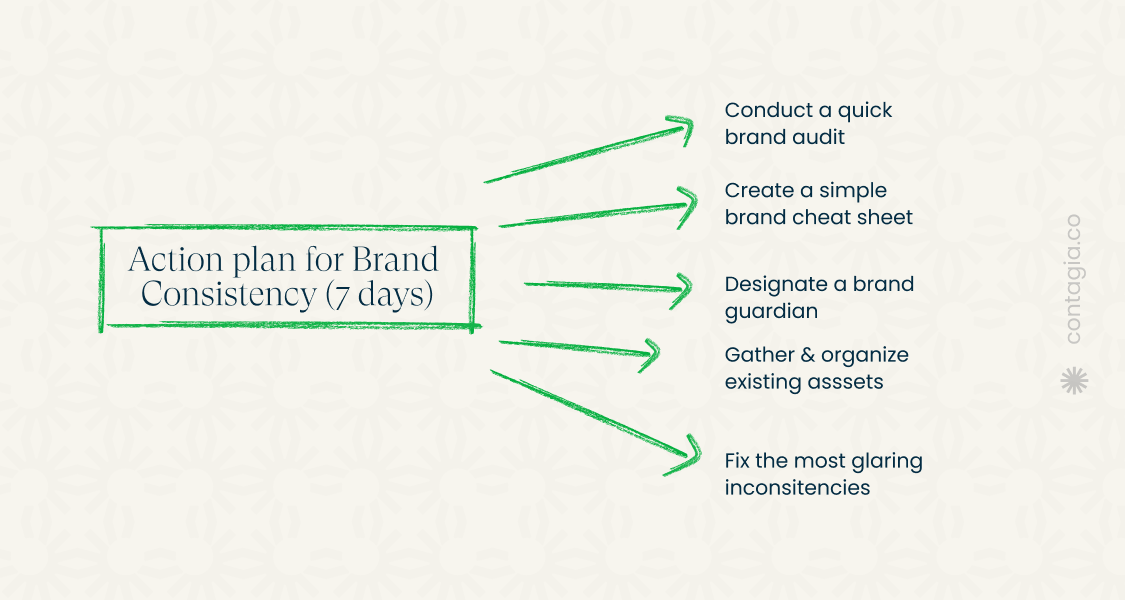
You can take these actions immediately, even with limited resources:
1. Conduct a quick brand audit: Gather all your customer-facing materials in one place and look for obvious inconsistencies.
2. Create a simple brand cheat sheet: Document your current logo files, color codes, fonts, and basic voice guidelines in a single accessible document.
3. Designate a brand guardian: Assign someone clear responsibility for maintaining brand consistency (even if it's just part of their role).
4. Gather and organize existing assets: Create a central repository for all your brand materials and delete outdated versions.
5. Fix the most glaring inconsistencies: Focus on your highest-visibility touchpoints first, website, social profiles, and email templates.
Medium-Term Strategy (1-3 Months)
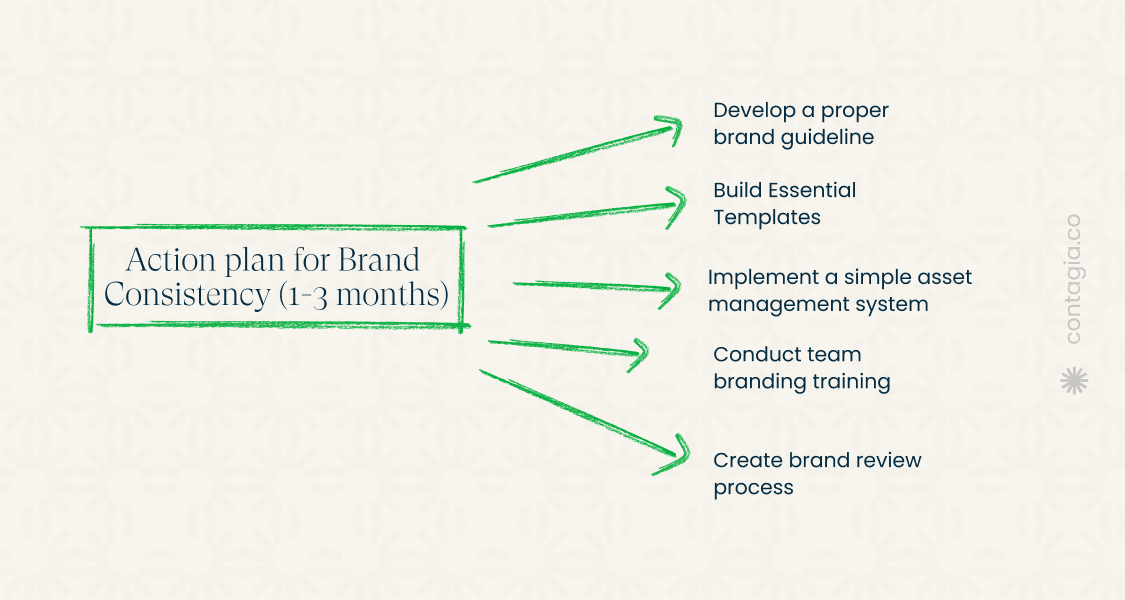
Once you've addressed immediate issues, focus on these foundational improvements:
1. Develop proper brand guidelines: Create comprehensive documentation covering all brand elements.
2. Build essential templates: Develop templates for your most common communication types.
3. Implement a simple asset management system: Set up a structured approach to storing and accessing brand materials.
4. Conduct team brand training: Ensure everyone understands why consistency matters and how to maintain it.
5. Create a brand review process: Establish lightweight approval workflows for customer-facing materials.
6. Set brand consistency metrics: Define how you'll measure improvement in consistency over time.
The Content Marketing Institute found that brands that implement even basic brand guidelines see a 23% increase in brand perception scores within 3-6 months.
Long-Term Brand Consistency Infrastructure (6-12 Months)
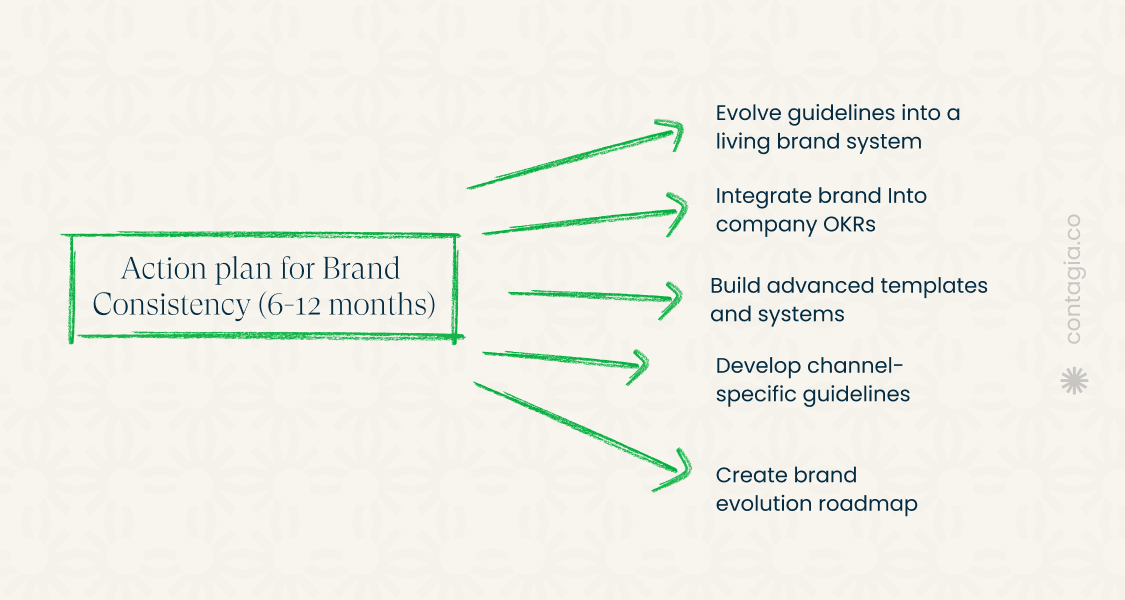
For sustainable brand consistency as you scale:
1. Evolve guidelines into a living brand system: Move beyond static documents to dynamic, accessible brand resources.
2. Integrate brand into company OKRs: Make brand consistency a measurable business objective.
3. Build advanced templates and systems: Create more sophisticated tools as your needs grow.
4. Develop channel-specific guidelines: Create focused guidance for each platform and context.
5. Implement regular measurement: Track brand consistency metrics quarterly.
6. Create a brand evolution roadmap: Plan how your brand will evolve intentionally rather than reactively.
Conclusion: Consistency as a Competitive Advantage
The struggle to maintain brand consistency is nearly universal among startups, but that’s exactly why getting it right gives you a sharp edge. When your brand speaks in one voice, looks like it knows itself, and delivers a consistent experience at every touchpoint, it builds the kind of trust that ads alone can’t buy.
At Contagia, we’ve seen time and again how startups don’t need massive budgets to achieve this — just the right systems, storytelling clarity, and design frameworks. If your team’s been growing fast and your brand feels like it’s fraying at the edges, it might be time to pause and realign.
Whether it’s building your brand from the ground up or refining what’s already there, we help early-stage and scaling startups create consistency that compounds, in perception, in trust, and eventually, in revenue.