Why a 90 Second Origin Story Video Usually Beats a 20 Slide Pitch Deck
by Naeem
6 Min Read
Published On : 14th June, 2026
- Introduction
- Subtopic-1
- Subtopic-2
- Subtopic-3
- Subtopic-3
- Conclusion
You're seven slides into your presentation, and the investor across from you glances at his watch. By the time you get to slide eight, he's bored. You never quite understood when his interest shifted from engaged to "when is this going to be over," and you might not have a great idea of why he got bored either.
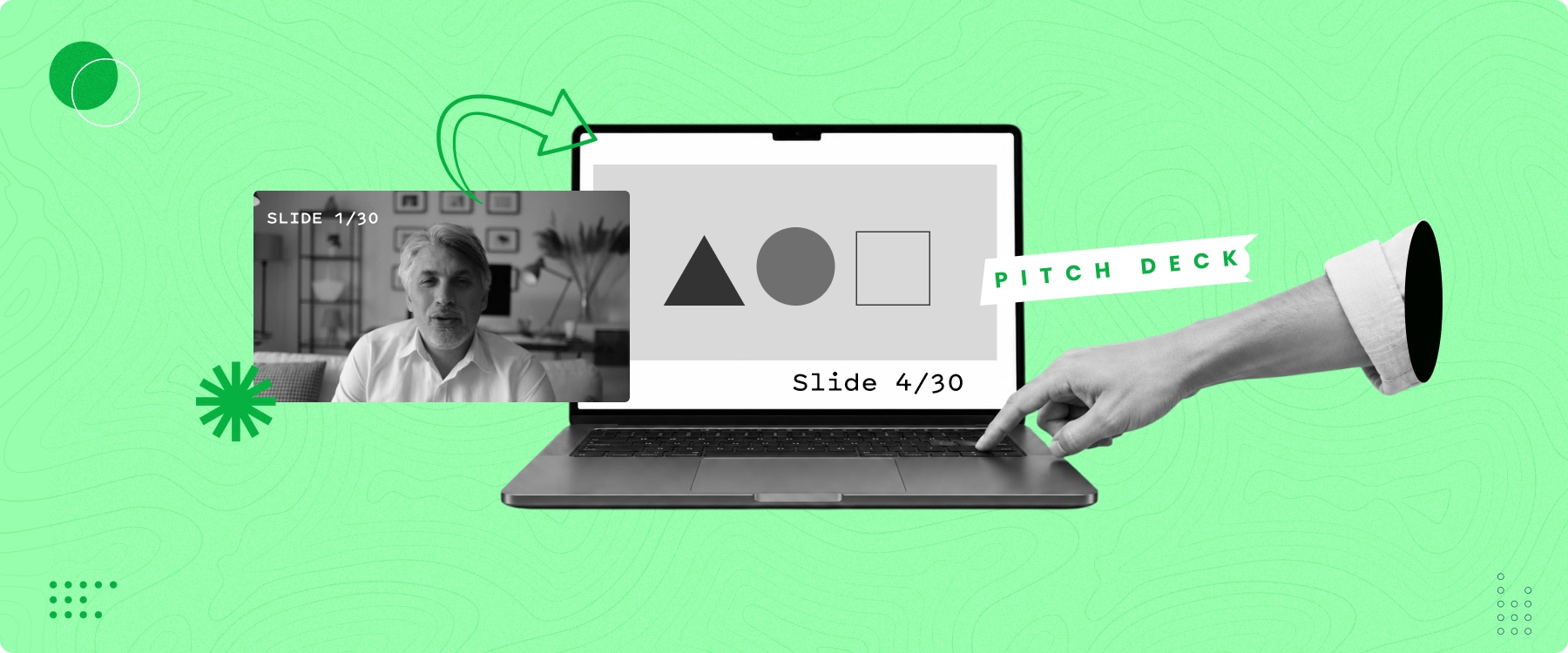
Now imagine the alternative. You start with a 90 second video. Your face appears on screen, and his eyes are immediately locked onto it. By the end, you've captured his attention. The two options may seem like an obvious choice, but the difference between a presentation full of slides versus a video telling your origin story has less to do with information, and more to do with connection.
Founders tend to default to putting together slides for their pitch decks because slides feel comprehensive, but what earns you a room's attention in the first ninety seconds isn't depth, it's connection. And that's what makes origin story videos so powerful.
Key Takeaways
- Use a 90-second origin story video to open a pitch or meeting, then bring in slides once you have the room's attention.
- Tone, facial expression, and eye contact do work that bullet points can't — save slides for financials, technical specs, and quarterly reviews.
- Specificity is the differentiator. "Founded in 2019" is forgettable; a concrete moment tied to a real frustration is what sticks and gets shared.
- Hook (0–10s) → Problem (10–30s) → Turning point (30–50s) → Solution (50–75s) → Vision + CTA (75–90s). Script to ~220–240 words.
- Founder-shot video with good audio and eye contact outperforms a slick, over-produced clip, but a $30–100 mic is non-negotiable.
- Caption everything (sound-off viewing is common), and export in the right aspect ratio per platform rather than reusing one cut everywhere.
- Website homepage, LinkedIn, email, and as slide 2 or 3 in a deck, the video earns its keep across every channel, not just the pitch room.
Why story beats slide in theory, and why you should use both
Princeton University has a neuroscientist named Uri Hasson who has studied something called "neural coupling", where the brain activity of the person listening to a story begins to mimic the brain activity of the person telling it. When we hear a story, the parts of the brain associated with language begin to fire up, but we also engage the motor cortex, the sensory cortex, and other areas associated with remembering and recalling. Storytelling is an inherently human experience, and research suggests that we're wired to connect to it.
Slides, on the other hand, are an uphill battle for engagement. According to Prezi's 2018 State of Attention report, only eight percent of people feel that most presentations keep their attention, and almost half of people admitted to checking email during a presentation. Even if your font choice has nothing to do with it, people are notoriously difficult to engage.
Retention is also a factor - we tend to forget ninety percent of what we hear within seventy-two hours. We remember things better when there's an image associated with them, and even better when there's a video with a story and emotion attached. Some studies even show up to an eighty percent retention rate of video.
That being said, slides are still useful - and necessary. You wouldn't want to put your financials or technical slides in a video, and most people would balk at watching a ninety second video to understand someone's cap table. The power of a ninety second origin story video is that it usually comes before slides - it gets you in the door, but slides still have their place once you're in the room.
The difference between the two media is that video has emotional weight, while slides have analytical heft.
What video gives you that slides don't
Emotion
UCLA professor Albert Mehrabian's research famously found that, when communicating feelings and attitudes, vocal tone and facial expressions can carry substantially more weight than the words themselves. His well-known 7–38–55 rule attributes 7% to words, 38% to vocal cues, and 55% to facial expressions.
Specificity beats vagueness
It's easy to say you were founded in 2019. It's harder to say you were founded in 2019 because you saw small manufacturers lose contracts to larger firms that had better supply chains, which made you realize that the playing field wasn't level. The latter statement has the same information as the former, but it's wrapped in specificity that makes it more relatable and engaging.
Compression vs summarization
Ninety seconds of video can tell a story better than twenty slides can summarize it. Visuals compress information in a way that text cannot, and there's real value in that. Showing your marketplace is more valuable than explaining it, and there's a reason that 3M research suggests that we process visuals 60,000x faster than text (though the exact number is almost certainly inflated).
It fits with skimming behavior
The average executive spends about 121 emails a day, so skimming is a part of life. You can skim a ninety-second video, but you can't really skim a twenty-slide PDF - one gets you the headline, while the other gets you the details. Over 75% of online video is viewed on mobile devices, which means the skimming behavior discussed previously is doubly important - people don't check emails on their phones while waiting for the bus, but they do watch videos.
What Goes Into a 90 Second Origin Story Video
There's a rough formula that works, which looks like this:
Hook (0-10 seconds)
Skip "Hi, I'm John, CEO of—." Open with the problem, not the solution, and make it recent enough that it feels personal. "Three years ago I watched a small business lose everything because they couldn't afford the tools big companies take for granted."
The problem (10-30 seconds)
Make it specific enough that people can relate to the struggle you're trying to solve. The thing that made you decide to start your company (30-50 seconds) What did you see that other people didn't?
The solution (50-75 seconds)
What did you build? Tell the story, not the specs. A brief demo can work better than a long lecture.
Your vision (75-90 seconds)
Where is this going? Always include a CTA, like visiting your website or scheduling a demo.
Some of the things that differentiate good videos from great ones:
Founder footage, beats hollow fanciness during the starting phases, where credibility is what you will be working to build. Eye contact is more important than production value. B-roll can give your eyes a rest without losing emotional connection. Text overlays should be sparse - maybe three to five cards at most - for the things that need to be read, not heard. Acknowledge the low point in your story, the moment you almost gave up, to build credibility with your audience. Use numbers to describe things like growth, scale, and impact, rather than adjectives. Instead of saying "we help thousands of companies," say "we helped a ten person agency reduce their reporting time by 85%."
When To Use Each Medium
Use video for pitches, first meetings, websites (most people say they'll buy from a company with video on its site, according to Wyzowl), LinkedIn posts, social media, and email. Use slides for unit economics and forecasts, technical slides, quarterly reviews, anything where the room needs to dig into the weeds.
The best option is usually to use both, in sequence. Put the 90 second origin story video at the beginning of a larger presentation to grab attention, or slide it into a presentation as a second or third slide to reset the skimming behavior people develop when looking at slides. The best option is almost always to show up somewhere with a video, unless there's a very good reason not to.
Where Most Origin Story Videos Go Wrong
Wistia does a lot of video analytics, and they've seen that engagement drops dramatically once videos get past two minutes, so ninety seconds is a good target to aim for.
This isn't the place to turn into a product/service demo either - ninety seconds is enough time to tell a story, not enough to show off everything your product/service does.
People will forgive bad production values, but they won't forgive bad audio, so if you can't afford a nice mic, invest in one (or a fifty dollar lavalier mic).
A lot of Facebook videos are watched with the sound off, so if you don't caption your video, you're losing a ton of potential viewers by default.
If you make a 16 video for YouTube and post it on TikTok, it'll be 9 and look squashed. Make sure to export the same video in different ratios for different platforms.
How To Actually Make One
The ideal step would be to hire a agency/freelancer, as production quality immediately attracts attention and builds credibility. Incase, if there is no budget to spare on getting a crew, motion designers & editors, here's a DIY step to handle it internally.
- Write down your problem, the moment you decided to start your company, what you built, and where you're going.
- Flesh these out into a script, then read them aloud, cutting anything that doesn't sound natural, and aim for around 220-240 words for a 90-second video. (This is usually where founders get stuck. Knowing your story and scripting it for camera are two different skills.)
- Get the gear. Your phone's camera, a nice mic, a tripod, and a window to use as a light source are all you need to make a decent video.
- Shoot a bunch of takes, and make sure to get B-roll of your office, your product, or your team.
- Edit it together in iMovie, or another free editing software, add some music, and put some text on the screen if you want. (The edit is where a rough recording either turns into something people actually watch, or gets left in a folder, pacing and structure do a lot of the work here.)
- Caption the video, and upload it to wherever you need it, making sure to put it in the right ratio for the platform.
- Put it everywhere. Your website, social media, email, your slides, etc. DIY, and you should spend two to four weeks on it.
If the story's clear but the approach isn't, how to shoot it, what to cut, what actually earns attention in ninety seconds- that's the part most teams get stuck on. At Contagia, we work with teams at exactly that stage: beginner-friendly plans that turn a rough idea into something worth watching, using whatever resources you've already got.
The Why Behind It All
Pitching with a twenty slide presentation is becoming less common, not because slides themselves are bad, but because attention spans have shrunk and people are much more likely to zone out when they're put in a position to be lectured to. Origin story videos are usually the clearest sign of why you're doing what you're doing, and that's why they're so powerful across all mediums. It's hard to quantify, but they feel right, and that's why they tend to work across audiences, from investors to customers to your own team.
Slides can always wait, but stories are always valuable.